A KTH × E.ON research collaboration, backed by the Swedish Energy Agency, building the business models, behavioral evidence, and digital tools that aim to enable virtual energy sharing in Sweden's distribution grids.
The EU has opened the door to virtual energy sharing through RED II and the Internal Electricity Market Directive — yet Sweden still has no concrete operational framework to put it into practice. This project aims to close that gap.
We develop a forward-looking business-model framework built for Swedish regulation, grid constraints, and customer rights — spanning regulatory mapping, stated-preference behavioral analysis, data-driven flexibility modeling, and grid-impact simulation on real low-voltage feeders. Each layer will be validated in a live pilot within E.ON's distribution network in southern Sweden.
A stated-preference instrument for customer behavioral research.
The platform is designed to implement a stated-preference survey for assessing customer willingness to participate in virtual energy sharing initiatives. Participants respond under hypothetical scenarios spanning political, economic, societal, technical, and environmental factors.
Results will inform the project's behavioral analysis and socio-economic benefit assessment, complementing data-driven flexibility models built from smart meter and DER metadata.
Open the platform
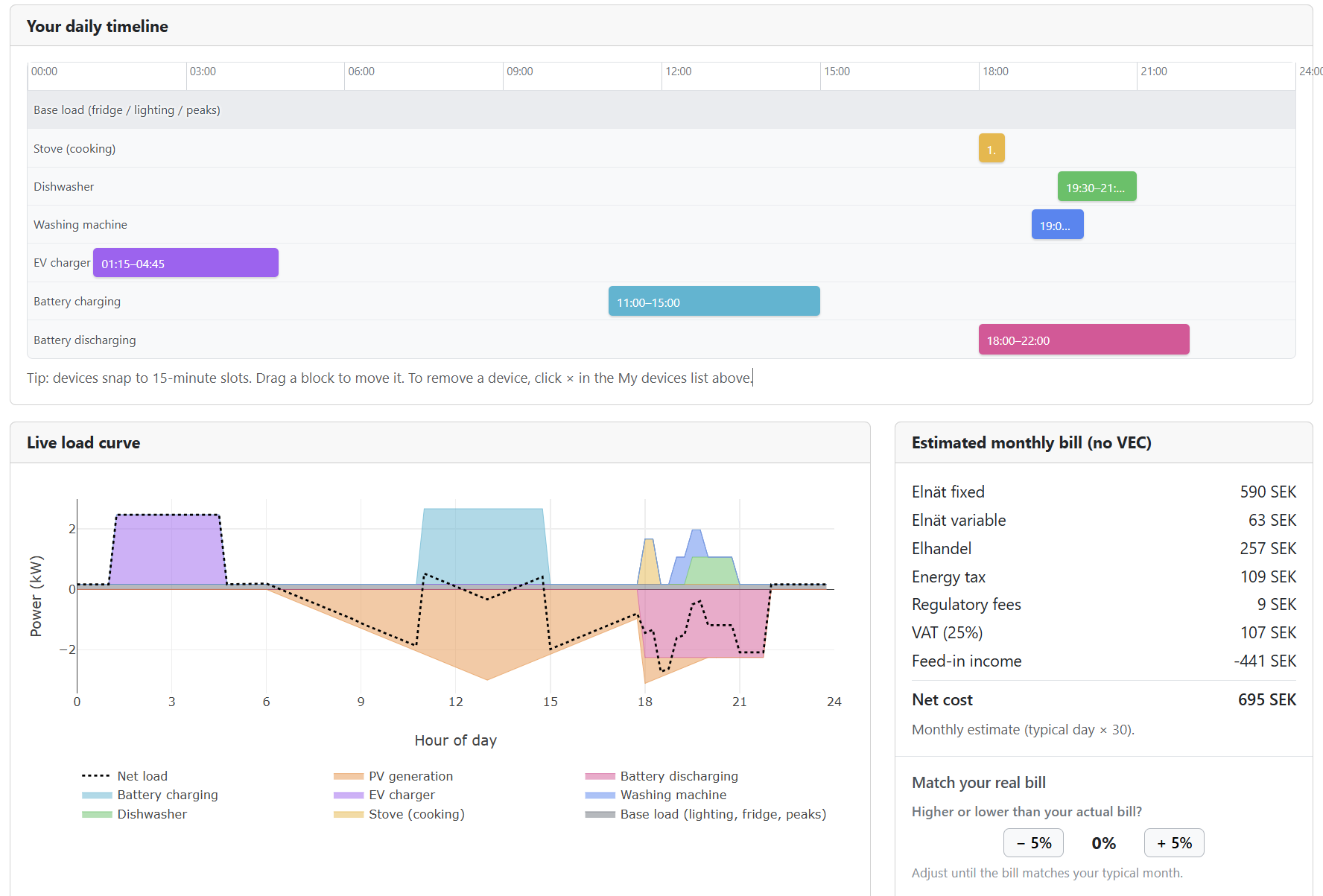
The pilot explores how virtual energy sharing can function in practice by testing digital solutions, business models and operational approaches that enable energy to be shared virtually through the existing electricity grid.
The pilot is carried out in Malmö and includes three commercial test customers consisting of property owners, representing a mix of residential and commercial properties with complementary energy profiles. The pilot will also include private customers within bidding zone SE4. By coordinating assets such as solar PV, batteries, and electric vehicles based on smart meter data and distributed energy resource operation logs, the project evaluates customer and system benefits across different sharing scenarios.
The pilot is expected to provide key insights into technical feasibility, market design, and future regulatory needs.
Researchers from KTH and partners at E.ON Energidistribution.